Spaces of a Constructive Dialogue
A konstruktív párbeszéd terei - a socially engaged public art programme
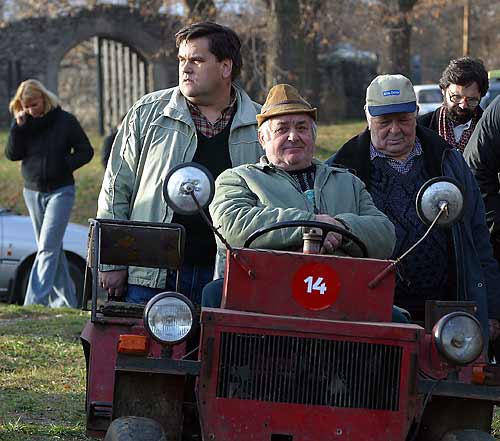 Lajos Gyenes with his self-created utility vechicle. Photo by Endre Koronczi.
This project, developed more than twenty years ago shortly after my participation in a UK future leaders programme, represents one of my earliest attempts to create a structured, collaborative platform for emerging artists and curators. Conceived and executed by a group of very young practitioners, the initiative combined curatorial experimentation, documentation, and network-building at a time when such cross-disciplinary approaches were far less formalised than today.
The archival documents reflect both the ambition and the limitations of that moment: they are exploratory, the documentation is uneven, but already articulate a clear intention to connect artistic practice with broader structures, and the selected artists and their work is timeless. Looking back, what is most striking is not the program’s polish, but its orientation toward collaboration, visibility, and long-term cultural positioning—principles that have remained central in my later work.
A decade after the project, several of the participants went on to establish themselves as significant figures in the cultural field, developing independent artistic practices and contributing to international exhibitions and curatorial platforms. For example, curator Barnabás Bencsik later became the director of the Ludwig Museum, Endre Koronczi one of the most respected and socially engaged creative artists of Hungary, the young photographer Gergő László founded Lumen, which remains an iconic cultural location in Budapest, and Samu Szemery, co-curator of the architectural interventions on the branch lines of Nógrád County railways, became one of the founders of Hungary’s Contemporary Architecture Centre. I remain grateful for their enthusiastic participation, bravery, and friendship.
For me, this work marks a formative moment: an early prototype of the ecosystem thinking that would later underpin initiatives such as Reprex and the Open Music Observatory in a much more formalised and technological form. While the documents belong to a different stage of life, they already reveal a consistent concern with how cultural value is created, documented, and sustained over time—an interest that continues to define my professional and research practice.
The programme itself, titled Spaces of a Constructive Discourse, was conceived as follows:
Spaces of a Constructive Discourse
The programme was conceived as a structured initiative to create new forms of dialogue between cultural production and public life in Hungary during a period of social and economic transition, just in the months of Hungary’s EU accession. It aimed to explore how public art and cultural interventions could contribute to addressing societal issues, particularly where traditional institutional channels were limited or ineffective. Rather than treating art as autonomous, the programme positioned it as an active medium for engaging with public concerns and social realities.
At its core, the initiative functioned as a multi-stakeholder platform, bringing together artists, sociologists, civil society actors, policymakers, and local communities. Through workshops, discussions, and pilot projects, it created a space where different forms of knowledge—artistic, social scientific, and administrative—could interact. The intention was not only to generate artistic outcomes, but to enable mutual learning and to integrate insights from cultural practice into broader policy and institutional frameworks.
A key objective of the programme was to expand participation in public discourse, particularly by including voices that had previously been excluded from decision-making processes. It sought to develop mechanisms through which cultural projects could surface local problems, articulate new perspectives, and feed these back into governance and reform processes. In this sense, the programme anticipated later approaches to participatory culture and socially engaged art, framing cultural activity as part of a wider system of societal feedback and transformation.
Operationally, the programme followed a structured workflow: identifying social problems, conducting research, implementing public interventions, and evaluating outcomes, followed by feedback loops into future actions. It also placed strong emphasis on partnerships and clearly defined roles (curators, coordinators, mediators). Taken together, it can be understood as an early attempt to design cultural production as a systemic, collaborative process—linking artistic experimentation with institutional learning and long-term social impact.
Daniel Antal
Founder of Reprex BV
My research interests include reproducible social science, economics and finance.