Főfotó
Locating, re-discovering, preserving and opening a large lost collection in Fortepan
Fortepan is not only an open, privately run photography archive, but has effectively become a Hungarian national institution. Originally built from rescued negatives found during informal “spring-cleaning” discoveries, it has grown into a subjectively curated yet widely used visual memory of Hungary before 1989. Still operated by a civil society organisation, Fortepan today collaborates with major institutions, contributes to exhibitions and publications, and increasingly serves as a repository for private and institutional photographic collections.
I have been involved with Fortepan as a user, volunteer, and donor for many years. My most significant contribution was the localisation and recovery of the long-lost negative archive of Főfotó, a centralised photographic enterprise created after the nationalisation of private studios in socialist Hungary. This organisation documented architecture, industry, public life, and everyday scenes, but its archive disappeared during the transition of the 1990s.
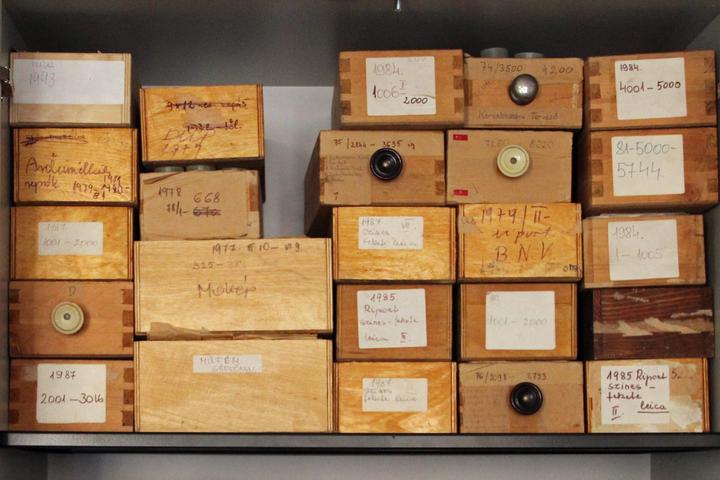
Through collecting and analysing historical negatives acquired on the art market, I identified traces of this lost archive and, together with Fortepan, initiated a process that led to its partial reconstruction. At this point, no institutional buyer had the resources or the legal capacity to buy this risky find, so I stepped into as a buyer. We transferred 400,000 negatives (for comparison: more than the permanent collection of the Dutch Photography Museum) in a van to Budapest from a tiny, almost derelict village.

After clarifying legal and provenance issues, which took quiet some time, the 400,000 that came in large banana boxes and their original drawer structure ( the most important physical organisational system that we wanted to preserve intact) this collection lived with me, filling much of my bedroom.
After a long process, the with surviving inventory records—were recovered, digitised in part by Fortepan, and ultimately deposited in the Budapest City Archives. This process required not only historical and technical expertise, but also careful negotiation around ownership, provenance, and public accessibility.
For me, this project represents a concrete example of how photographic heritage can be reconstructed outside institutional frameworks and later reintegrated into them. It reflects a long-standing interest in the lifecycle of collections—how they are created, lost, rediscovered, and reinterpreted—and in the role that individuals and civic initiatives can play in preserving cultural memory.
Daniel Antal
Founder of Reprex BV
My research interests include reproducible social science, economics and finance.